Harbin Travel Guide: Best Things to Do & Itinerary Ideas
Harbin is located in northeastern China and has a population of about 9.4 million. It is widely known as China’s “Ice City” because of its long, cold winters and famous ice and snow attractions.
Winter temperatures in Harbin are extremely cold. Average winter temperatures usually range from –15°C to –20°C (5°F to –4°F), and during cold snaps they can drop below –30°C (–22°F). Since many major attractions are outdoors, dressing warmly is essential.
Late December to February is the peak travel season. The Ice and Snow World is usually not fully completed by mid-December, while ice sculptures may begin melting by late February. During peak season, visitor numbers are very high. Try to avoid weekends, and especially avoid Chinese New Year (February 15–23, 2026; February 5–13, 2027).
In the early 20th century, more than 100,000 ethnic Russians lived in Harbin. As a result, you will still see historic buildings with strong Russian architectural influences throughout the city.
Harbin’s economy is relatively modest compared with China’s largest cities, generally ranking around 30th–35th nationwide.
Harbin locals are known for being warm and friendly. They enjoy socializing and take pride in their city’s unique culture.
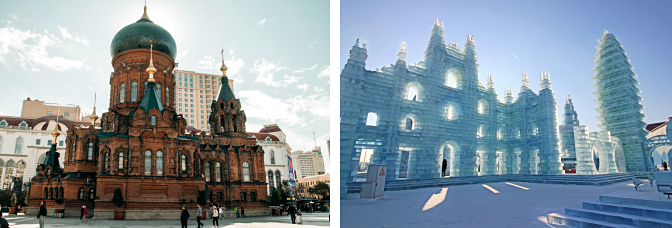 by Hongwei FAN | Erica Li
Getting to Harbin from Beijing
Harbin is located about 1,250 km (780 miles) northeast of Beijing.
The most convenient way to travel between the two cities is by high-speed train.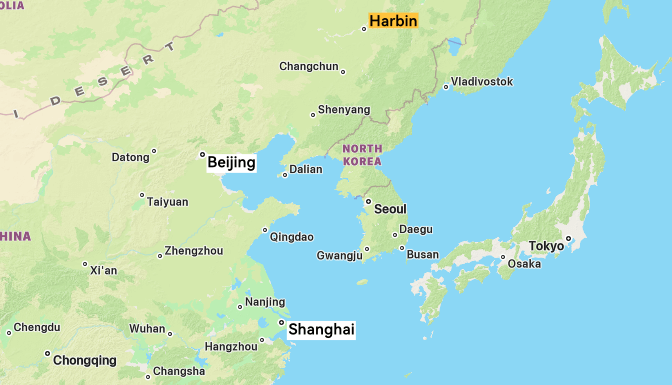
Multiple trains run daily between Beijing and Harbin.
Most trains depart from Beijing Chaoyang Station and arrive at Harbin West Station(Haerbinxi).
Travel time: approximately 4.5–5.5 hours
Fares(one-way, approximate):
Second Class: around ¥600
First Class: around ¥900
Business Class: around ¥1,800
You can check train schedules and ticket prices on the official China Railway 12306 website or Trip.com, China’s largest online travel agency.
- Traffic around Beijing Chaoyang Railway Station can be heavy, especially during weekday morning rush hours. It is best to avoid peak hours or use the subway to reach the station.
- Harbin West Railway Station is about 10 km (6 miles) from Central Street, the city’s main tourist area. A taxi ride takes around 20 minutes in light traffic and costs about ¥25, while the metro takes roughly 40 minutes and costs ¥4 per person.
Getting to Harbin from Other Cities
Harbin is located in northeastern China and is relatively far from most major cities in the country. Flying is usually the most practical option for travelers coming from elsewhere in China.
Harbin Taiping International Airport is located about 40 km (25 miles) from downtown, with a driving time of around 50 minutes in normal traffic.
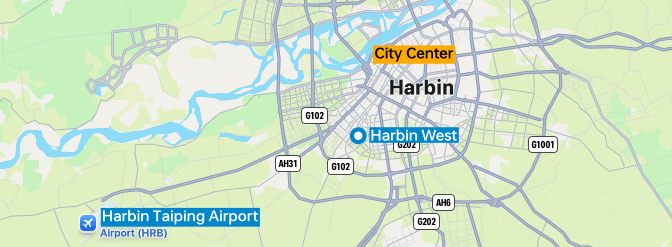
Getting from the Airport to the City
Airport Shuttle Bus (Recommended)
The airport shuttle bus is the most popular option among locals and offers the best balance of reliability and value. Tickets cost ¥20, with buses running every 15 minutes from 4:00 am to 9:00 pm. The journey to the city usually takes 1–1.5 hours, depending on traffic. Follow airport signs to the boarding area at Exit 7 on the 1st floor of Terminal 2. Tickets can be purchased on-site from self-service machines or staffed ticket counters. There are eight shuttle routes, and Route 3 goes directly to Central Street. An Ibis hotel (Ibis Harbin Central Street Airport Bus Station Hotel) is located near one of the drop-off points.Taxi
Taxis are easy to find by following airport signs to the official taxi stand. A ride to downtown typically costs ¥120–160, depending on traffic and your exact destination.Ride-hailing Services
Ride-hailing services are usually slightly cheaper than taxis, costing around ¥100, but the pickup process can be confusing due to crowds. Pickup locations are not fixed, and drivers often call passengers and ask them to walk to a parking area. If you do not speak Chinese, this option can be difficult to manage.
If you are leaving Harbin on an early morning flight, plan to arrive at the airport 2–3 hours in advance. Early flights are often cheaper and therefore very busy, leading to long lines for check-in and security. If you are worried about missing your flight, inform airport staff, who may arrange access to a fast-track lane. For convenience, you may also consider staying near the airport, such as at Mclaren Business Hotel.
Where to Stay in Harbin
Hotels Near Airport Shuttle Bus Stops
Ibis Harbin Central Street Airport Bus Station Hotel
The hotel is located directly on Central Street, next to the airport shuttle bus drop-off point, and is an 8-minute walk from Central Street Metro Station. While the location is very convenient—with just a 10-minute metro ride to the Ice and Snow World—room rates are relatively high, and similarly priced hotels in less central areas often offer better value or larger rooms
Country Inn by Radisson, Central Street, Harbin
About 400 meters (a 6-minute walk) from the airport shuttle bus stop on Central Street, and within 5 minutes’ walk of Central Street Metro Station.
Hotels Near Harbin West Railway Station
If you are arriving in Harbin by high-speed train from Beijing, staying right next to the station is usually not ideal due to limited hotel options. A better choice is to take one metro stop to Kaishengyuan Square, where you’ll find a wider range of good-value hotels next to a shopping mall, making dining and shopping convenient. The main drawback is the longer daily commute, with travel times of around 30 minutes by taxi (12 km) or 50 minutes by metro to the Ice and Snow World.
Recommended options:
Ibis (Harbin West Railway Station Wanda Square Branch)
Crystal Orange Hotel (Harbin West Railway Station Wanda Plaza)
Other Good Hotel Areas Near Metro Stations
Harbin Central Street Habsburg Hotel (Sofia Church)
Located directly above Friendship Palace Metro Station. It is about 15 minutes by metro to the Ice and Snow World, and a 10-minute walk to Central Street and the Songhua River Ice & Snow Carnival area.
Hampton by Hilton Harbin Zhongyang Street
A 5-minute walk to Museum Metro Station. Despite the hotel name, Central Street is about a 30-minute walk away. From Museum Station, it takes around 15 minutes by metro to the Ice and Snow World.
Harbin Itinerary & Getting Around
Sample 3-Day Itinerary
Day 1: Spend the day at Sun Island Snow Expo, then head to Zhongyang (Central) Street in the evening and visit Saint Sophia Cathedral.
Day 2: Visit Harbin Polarland in the morning, and enjoy snow activities at the Songhua River Ice & Snow Carnival in the afternoon.
Day 3: Explore Siberian Tiger Park in the morning, then end the day at the Ice and Snow World in the afternoon or evening.
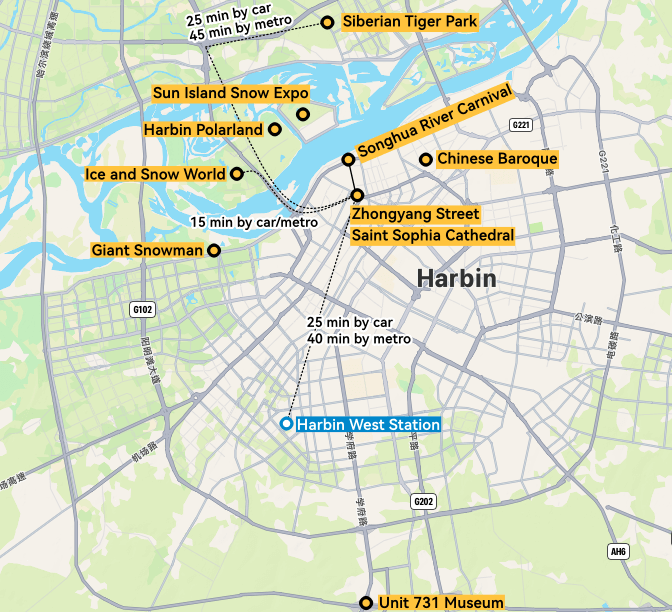
Getting Around Harbin
- Taxis and ride-hailing services are generally the most convenient and affordable way to get around the city. However, they can be hard to find during peak hours, especially in the evening around Zhongyang Street and the Ice and Snow World.
- The metro system serves most major attractions and is the most reliable form of transportation in winter. Trains typically operate from around 5:30 am to 11:00 pm. Fares depend on distance and usually range from ¥3 to ¥7. Tickets can be purchased using Alipay or from staffed ticket counters at metro stations. Contactless tap-to-pay is not currently supported.
Maps and Navigation Tips
Google Maps is not reliable in China, as much of the data is outdated.
For navigation, use Apple Maps if you are on an iPhone, or download AMap (Gaode Maps), the English version of China’s most widely used mapping app.
Popular Attractions in Harbin
Harbin Ice and Snow World
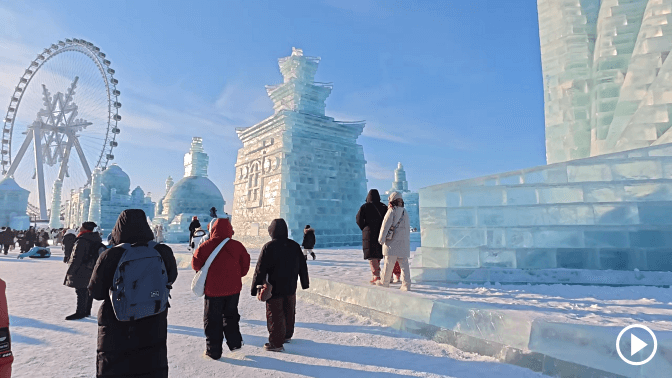
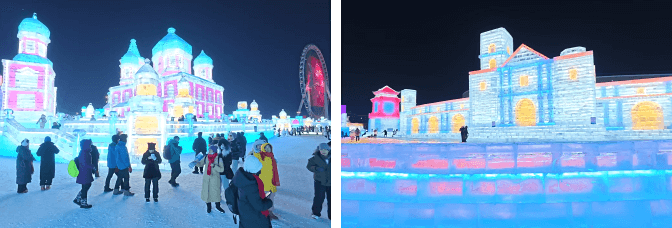
Harbin Ice and Snow World is the world’s largest ice and snow theme park, covering approximately 1.2 million square meters. It is famous for its massive ice sculptures and spectacular light shows, and has been held annually since 1999 (currently in its 27th edition).
Hours: Late December to mid-February, 11:00 am – 10:00 pm
Admission: Adults ¥325, Children ¥240
tickets can be purchased on-site or through Trip.com
Recommended Visit Time:
2 hours if you only want to see the ice sculptures; up to 5 hours if you plan to see the sculptures, enjoy rides, and watch performances.
Tips for Visiting:
- Day vs. Night: Ice sculptures are easier to photograph during the day, but the light displays at night are spectacular. Sunset is around 4:00 pm, but note that visitor numbers increase sharply after dark.
- Rides and Shows: Besides ice sculptures, there are ice slides, a Ferris wheel, and Car/Motorcycle stunt performances, all included in the ticket price.
- Ice Slide & Ferris Wheel Reservations: For the large ice slides (521 m and 365 m) and Ferris wheel, you need to scan a QR code inside the park to reserve a time slot. Reservations can be competitive and usually sell out in about 20 seconds. Even if you secure a spot, expect 30–60 minutes of outdoor waiting (shorter during the day, up to 1 hour after 4:00 pm). For this reason, it’s recommended to enjoy the snow expo and ice slides during the day and visit Ice and Snow World in the evening for the ice sculptures.
- Restrictions: Large ice slides are limited to visitors aged 15–60 and at least 1.6 meters (5'3") tall.
- Dress Warmly: Harbin winter is extremely cold—dress in multiple layers and wear proper winter gear.
- Food & Amenities: There are a few outdoor snack stalls, but most restaurants are located in the Ice and Snow Food Hall, where you can warm up if needed. Portable chargers are available for rent on-site.
Getting There:
Take Metro Line 2 to Ice and Snow World Station. While the metro can be crowded (especially around 9:00 pm), it is more reliable than trying to get a taxi in the evening. For convenience, it’s recommended to stay at a hotel near a metro station.
Watch: The 26th Harbin Ice and Snow World
Recommended Xiaohongshu Post: 哈尔滨冰雪大世界冰天游玩冰滑梯 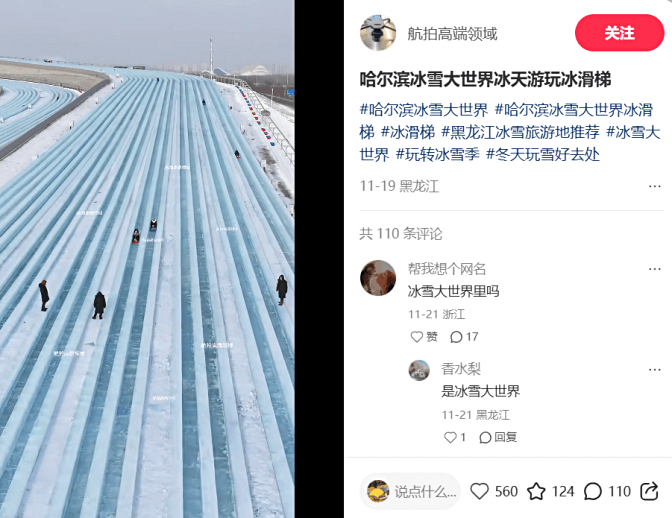
Sun Island International Snow Sculpture Art Expo
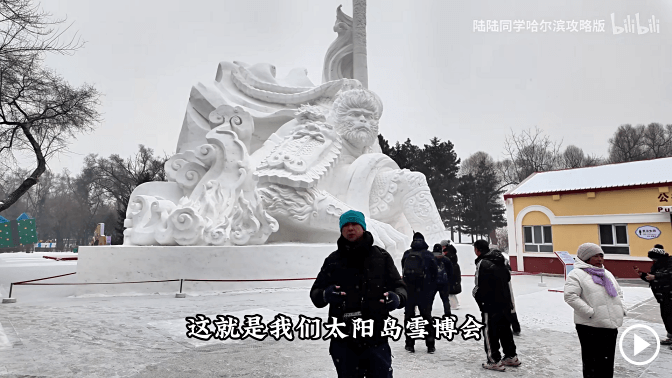
Sun Island covers approximately 1.5 million square meters and features a large number of impressive snow sculptures. Unlike Ice and Snow World, it is only open during the day. However, it tends to be less crowded, and visitors can enjoy the 240-meter-long ice slide multiple times with minimal waiting—usually about 5 minutes (compared with the 500-meter ice slides at Ice and Snow World, which can require a one-hour wait). Most attractions, including the ice slide, ice bicycles, and carousel, are included in the admission ticket, so no extra payment is needed.
Hours: Late December to mid-February, 9:00 am – 5:00 pm
Admission: Adults ¥198, Children ¥120
tickets can be purchased on-site or through Trip.com
Recommended Visit Time: 2–4 hours
Tips for Visiting:
- Visiting in mid-December may allow you to enter the park at a lower ticket price, but large snow sculptures may not be fully completed, the ice slide might not be ready, and ground snow coverage may be insufficient. Late December through February is the best time to visit.
- Sun Island is very large, and many attractions are deep within the park. Considering that sunset occurs around 4:00–4:30 pm, avoid arriving too late in the day.
- utside winter, Sun Island functions as a regular city park, and a visit is optional.
Getting There:
Take Metro Line 2 to Sun Island Station; the park entrance is right outside the station. The metro is recommended, as taxis can get stuck in traffic.
Watch: 哈尔滨雪博会攻略,仅此一份
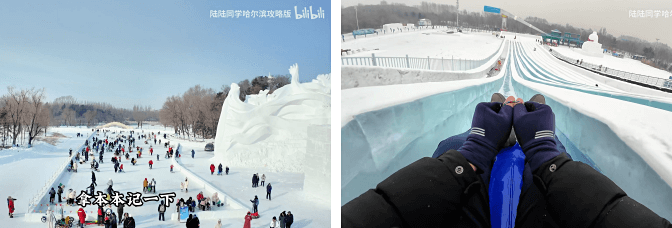
Songhua River Ice and Snow Carnival
The Songhua River stretches 1,927 km, with 466 km passing through Harbin city. In winter, when the river freezes, the section near Harbin Flood Control Monument Square is transformed into the Ice and Snow Carnival.
Hours: Late December to mid-February, 9:30 am – 9:30 pm
Admission: Free entry; individual attractions have separate fees
Recommended Visit Time: 1–2 hours
Tips for Visiting:
- Most attractions charge ¥30–50 per activity. There is also a ¥298 package for 10 activities, but many of them are repetitive and the package is not recommended.
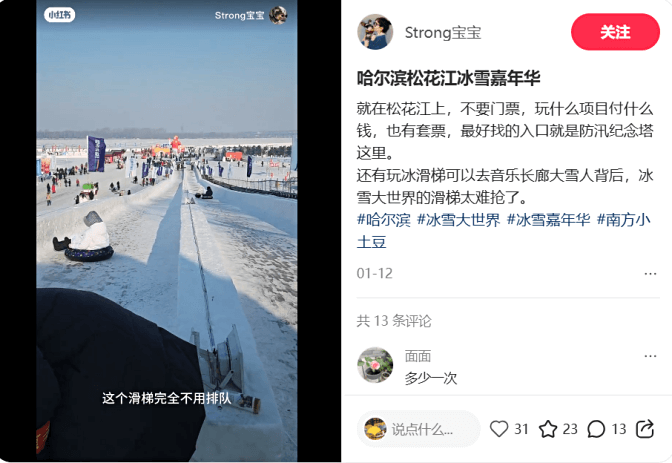
- If you are visiting with children, it’s best to rent a snow tube (¥30 rental + ¥100 deposit) and enjoy the ice and snow slides for free. Note that the snow slides and ice slides are located far apart.
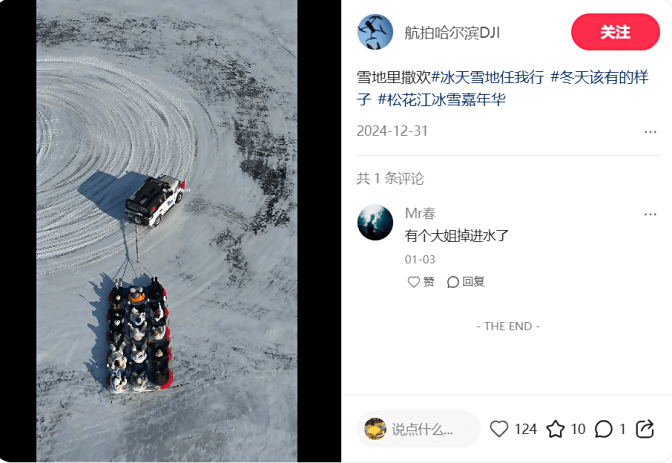
- The most popular attraction is snow tube drifting, where a jeep pulls the tube in circles. This costs ¥50 per ride.
Getting There:
Take Metro Line 3 to Friendship Palace Station and walk about 10 minutes. If taking a taxi, set your destination to Harbin Flood Prevention Memorial Tower Square.
Watch: Harbin Songhua River Carnival

Recommended Xiaohongshu Post: 航拍哈尔滨DJI
Recommended Xiaohongshu Post: 哈尔滨松花江冰雪嘉年华
Siberian Tiger Park
Siberian Tiger Park, established in 1986 and covering 1.44 million square meters, is the world’s largest breeding and conservation center for Siberian tigers. The park started with only 8 tigers, and through breeding and conservation efforts, now houses approximately 300 tigers.
Hours:
Spring/Summer/Fall: 8:00 am – 5:00 pm
Winter: 8:30 am – 4:30 pm
Admission:
Adults ¥90, Children under 18 half-price, Free for children under 1.2 m tall or visitors over 65
Sightseeing Bus: ¥20 for the Ordinary Bus, ¥40 for the Thrilling Bus (in winter, only the Thrilling Bus operates)
tickets can be purchased on-site or through Trip.com
Recommended Visit Time: 1–2 hours
How to visit:
The usual route is to take the sightseeing bus first, then explore the walking area. A bus ticket is required.
Ordinary Bus and Thrilling Bus follow the same route. The Ordinary Bus usually has shorter lines, but only the Thrilling Bus allows you to feed tigers or watch others feed them.
The Thrilling Bus comes in two versions: one with metal bars and one with special glass windows; prices are the same, so choose based on preference.
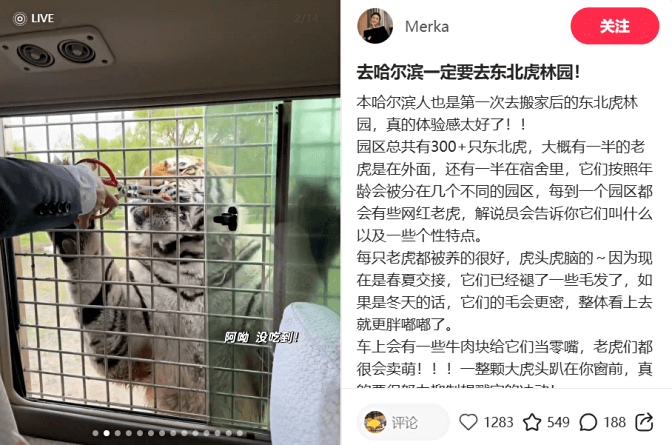
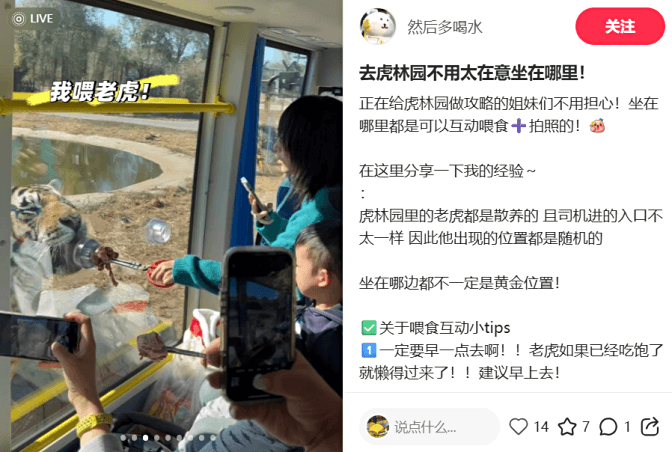
While on the Thrilling Bus, you can buy meat sticks from the driver (5 sticks per bucket, ¥20 per stick) to feed the tigers. Payment is made after feeding.
The walking area includes a small pet tiger area, where you can see young tigers roughly the size of a house cat.
Getting There:
There is no nearby metro. Taxis are recommended. The park is about 13 miles (25 minutes) from Central Street.
Watch: Harbin Siberian Tiger Park
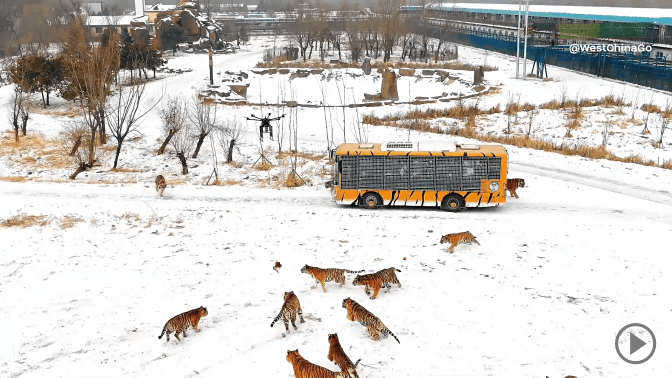
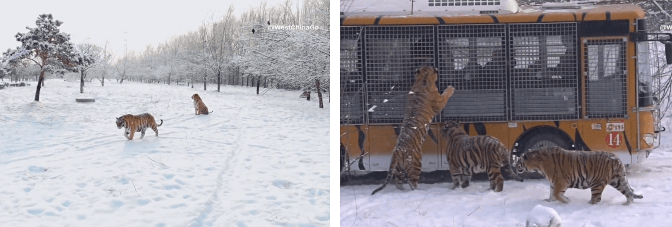
Recommended Xiaohongshu Post: 去哈尔滨一定要去东北虎林园
Recommended Xiaohongshu Post: 去虎林园不用太在意坐在哪里
Harbin Zhongyang Street / Central Street
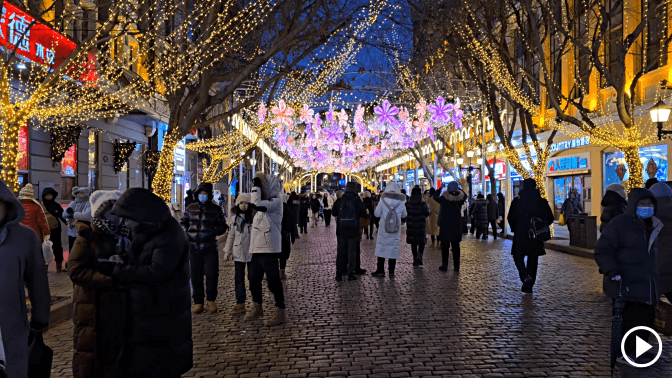
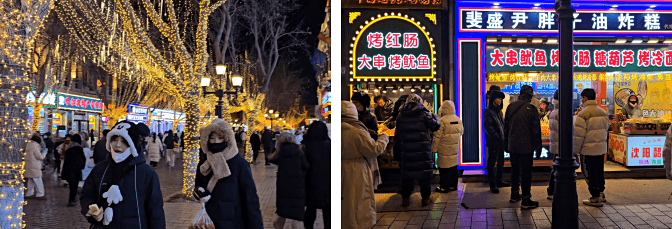
Central Street is about 1,450 meters long and 21.34 meters wide, lined with many European-style and European-inspired buildings, giving the street a unique architectural charm.
Recommended Visit Time: 30 minutes – 1 hour
Getting There: Take Metro Line 2 to Zhongyang Street Station, then walk east about 300 meters.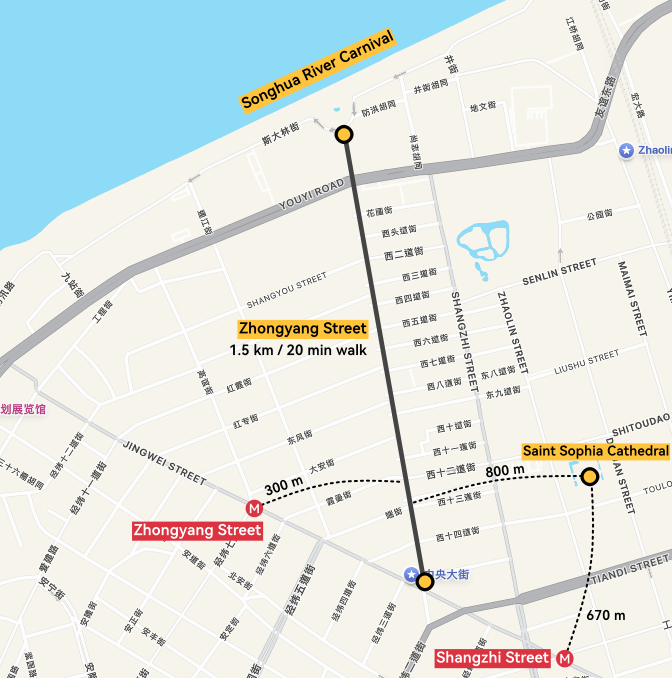
Watch: HARBIN CENTRAL STREET ZHONGYANG DAJIE ONE OF THE FAMOUS STREETS IN HARBIN
Notes:
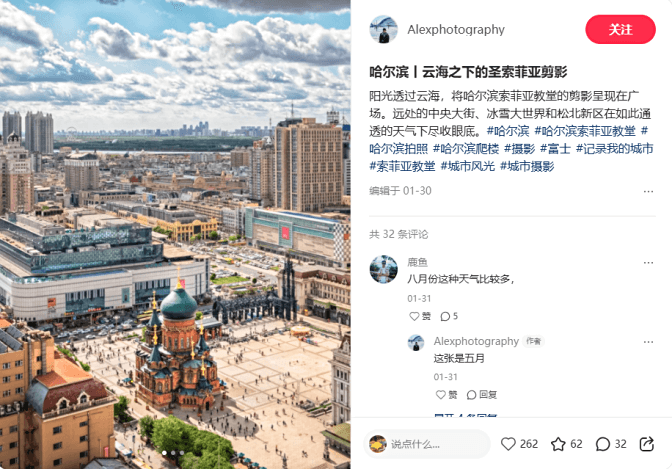
Saint Sophia Cathedral is located near Central Street. Built in 1932 in the Byzantine architectural style, it was once the largest Orthodox church in the Far East. During that period, Russia sent many engineers and soldiers to Harbin to construct the China Eastern Railway, and the cathedral served the Russian community for religious activities. In 1931, when the Japanese occupied Harbin, many Russian residents fled to southern Chinese cities such as Shanghai. After the founding of the People’s Republic of China in 1949, the cathedral was converted into a museum and has been open to the public ever since. Visitors can take photos outside or pay ¥25 to enter (closed on Mondays).
Watch: 哈尔滨圣索菲亚教堂
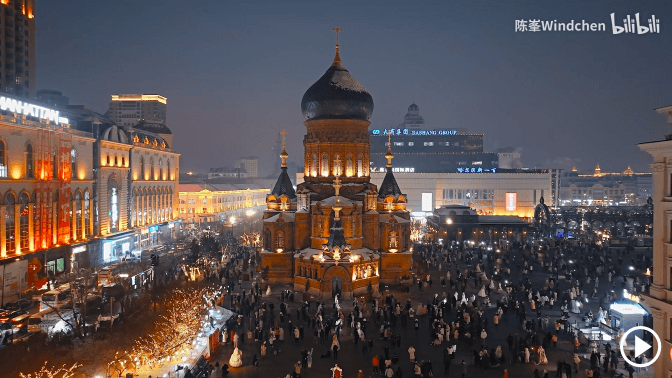
Recommended Xiaohongshu Post: 云海之下的圣索菲亚剪影
Lesser-Known Attractions
Harbin Polarland
Hours: 9:00 am – 5:00 pm
Admission:
Polarland ¥198, Oceanarium ¥130, Penguin Hall ¥70
3-attraction combo ticket ¥308, Children ¥210 Trip.com tickets
Recommended Visit Time: 2 hours – a full day
How to visit:
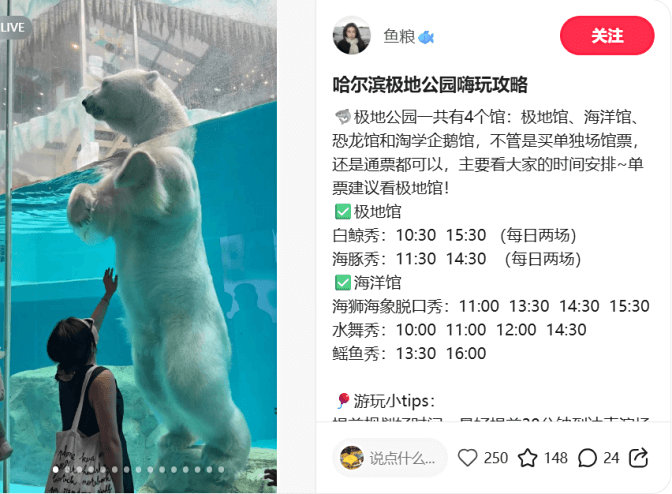
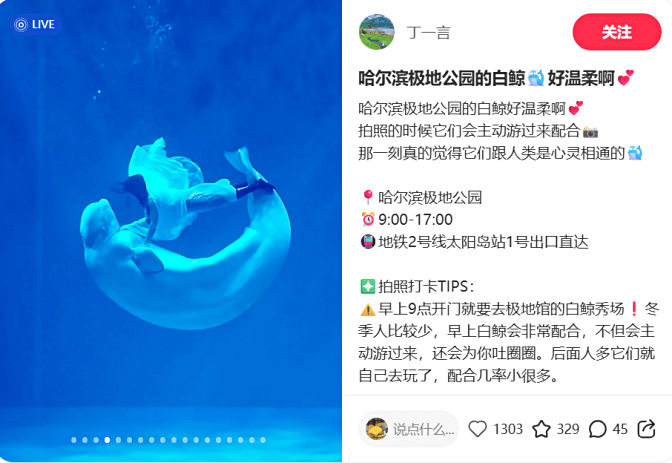
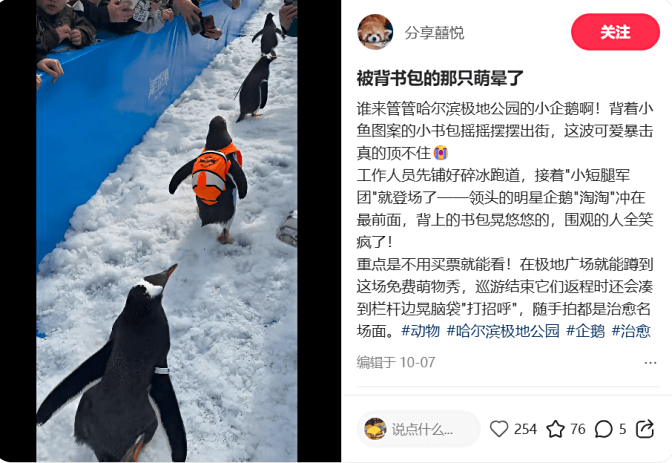
The Polarland Pavilion is a must-see. Don’t miss the beluga whale show (at least 2 performances: 10:30 am and 3:30 pm) and the dolphin show (at least 2 performances: 11:30 am and 2:30 pm). In winter, be sure to catch the penguin parade, usually held twice daily (10:30 am and 1:30 pm) on the plaza. It’s free and does not require entry into the Penguin Hall, though shows may be canceled due to weather or the penguins’ health.
Getting There:
Take Metro Line 2 to Sun Island Station. Exit 1 leads directly to Polarland, while exit 2 leads to the Oceanarium.
Recommended Xiaohongshu Post: 哈尔滨极地公园嗨玩攻略
Recommended Xiaohongshu Post: 哈尔滨极地公园的白鲸好温柔啊
Recommended Xiaohongshu Post: 被背书包的那只萌晕了
Giant Snowman in Qunli Music Park
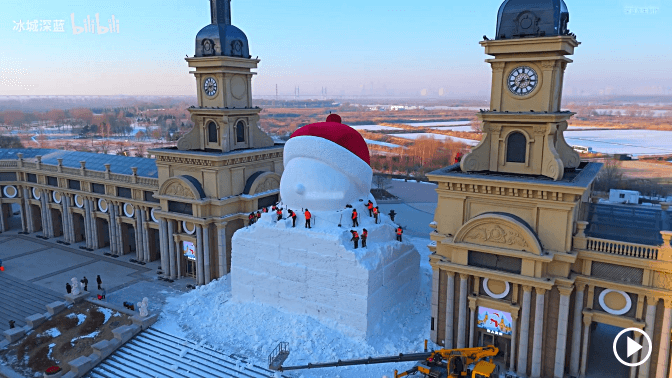
During the COVID-19 pandemic in 2020, sanitation workers had a spontaneous idea to build a giant snowman in the music corridor after work. Though it looked a bit rough, it brought warmth and joy to citizens during the cold winter. Later, the Harbin city government decided to fund professional teams to build an extra-large snowman each year to decorate the streets. The current snowman is approximately 20 meters tall, 14 meters long, and 11 meters wide, wearing a red hat and red scarf.
Hours: Late December to mid-February, open 24 hours
Admission: Free
Recommended Visit Time: 10 minutes – 2 hours
How to visit:
- Most visitors just stop to admire the snowman briefly, but the view is most impressive after the lights turn on at 4:00 pm.
- Behind the snowman is a small play area, with rides that charge separately (e.g., ice slides cost about ¥20 per ride, with waiting times of 30–60 minutes).
Getting There: There is no nearby metro station. Taxis are recommended, set your destination to Qunli Music Park Daxueren.
Watch: 群力音乐长廊大雪人
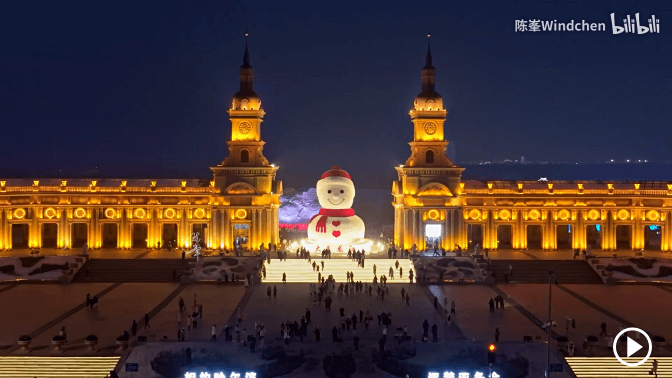
Watch: 音乐长廊挖大雪人一镜到底
Chinese Baroque Historical Block
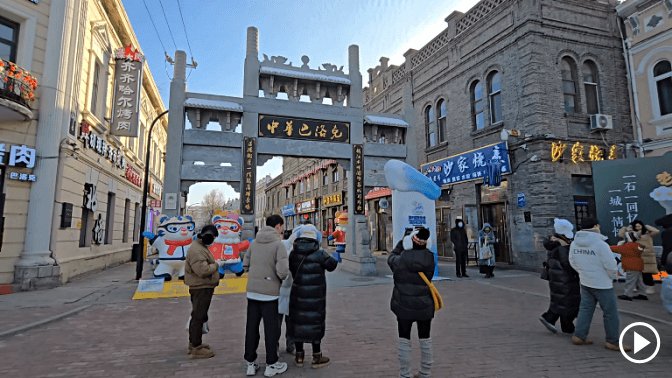
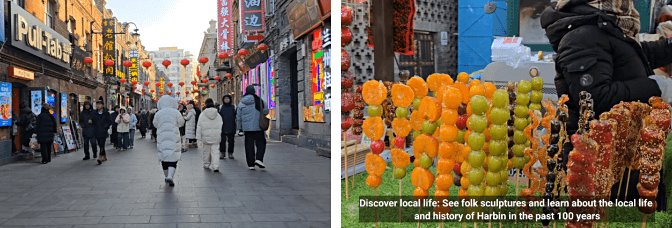
The Chinese Baroque style combines European Baroque architecture with traditional Chinese decorative motifs such as peonies, pomegranates, and bats, symbolizing good luck and prosperity. The building structure is adapted to a Chinese-style courtyard (siheyuan). Constructed in the early 20th century, this area now mostly houses souvenir shops and restaurants. It’s similar to Harbin’s Central Street but generally less crowded.
Hours: Most shops open 10:00 am – 9:00 pm
Recommended Visit Time: 30 minutes – 1 hour
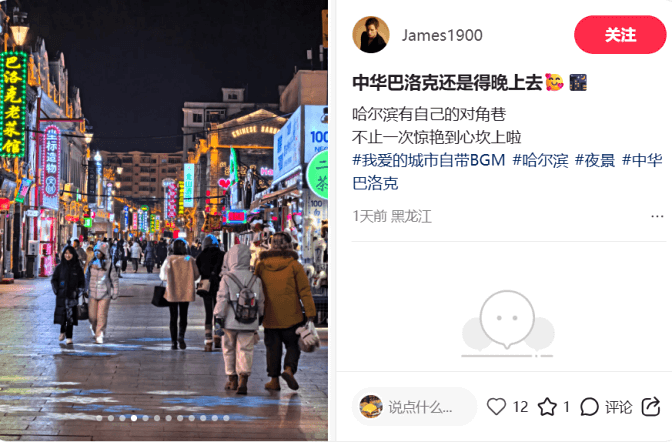
Tips for Visiting: The street looks especially beautiful in the evening.
Getting There: Take Metro Line 3 to Chinese Baroque Block Station; Exit 1 leads directly to the block.
Watch: THE LARGEST PRESERVED AREA OF CHINESE BAROQUE ARCHITECTURE IN CHINA
Recommended Xiaohongshu Post: 中华巴洛克还是得晚上去
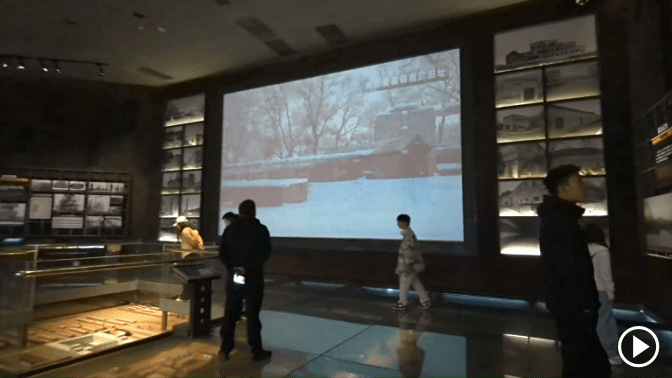
Unit 731 Museum
Harbin is a city of joy and festivities, but like many cities around the world, it also carries a somber history that should not be forgotten.
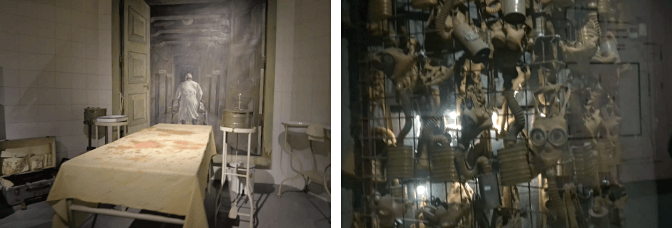
Unit 731 was Japan’s biological and chemical warfare research unit during World War II. It has been described as Japan’s version of “Joseph Mengele plus the Dachau concentration camp medical experiments”, infamous for conducting human experiments in China, Korea, Thailand, Singapore, Malaysia, the Philippines, and Indonesia. Harbin served as the core base of the unit.
The museum consists of two main areas:
- Exhibition Hall: Introduces the history of Unit 731, biological warfare, and the development and destruction of evidence related to chemical and biological weapons.
- Site Area: Includes original facilities such as laboratories, prisons, frostbite testing rooms, and cremation furnaces. Exhibits have bilingual descriptions in Chinese and English.
Hours: Tuesday to Sunday, 9:00 am – 5:30 pm (closed on Mondays)
Admission: Free; foreign visitors do not need a reservation
Recommended Visit Time: 1–2 hours
Getting There: Take Metro Line 1 to Xinjiang Street Station, exit 3, and walk about 400 meters.
Watch: TRAVEL HARBIN, CHINA: HAVE YOU HEARD OF JAPAN’S UNIT 731
Thank you for reading. Hope you have a wonderful journey! ヽ(´▽`)/